The paper workshop
Flat slices, slots, and a volume that appears. Discover another way to build in paper.
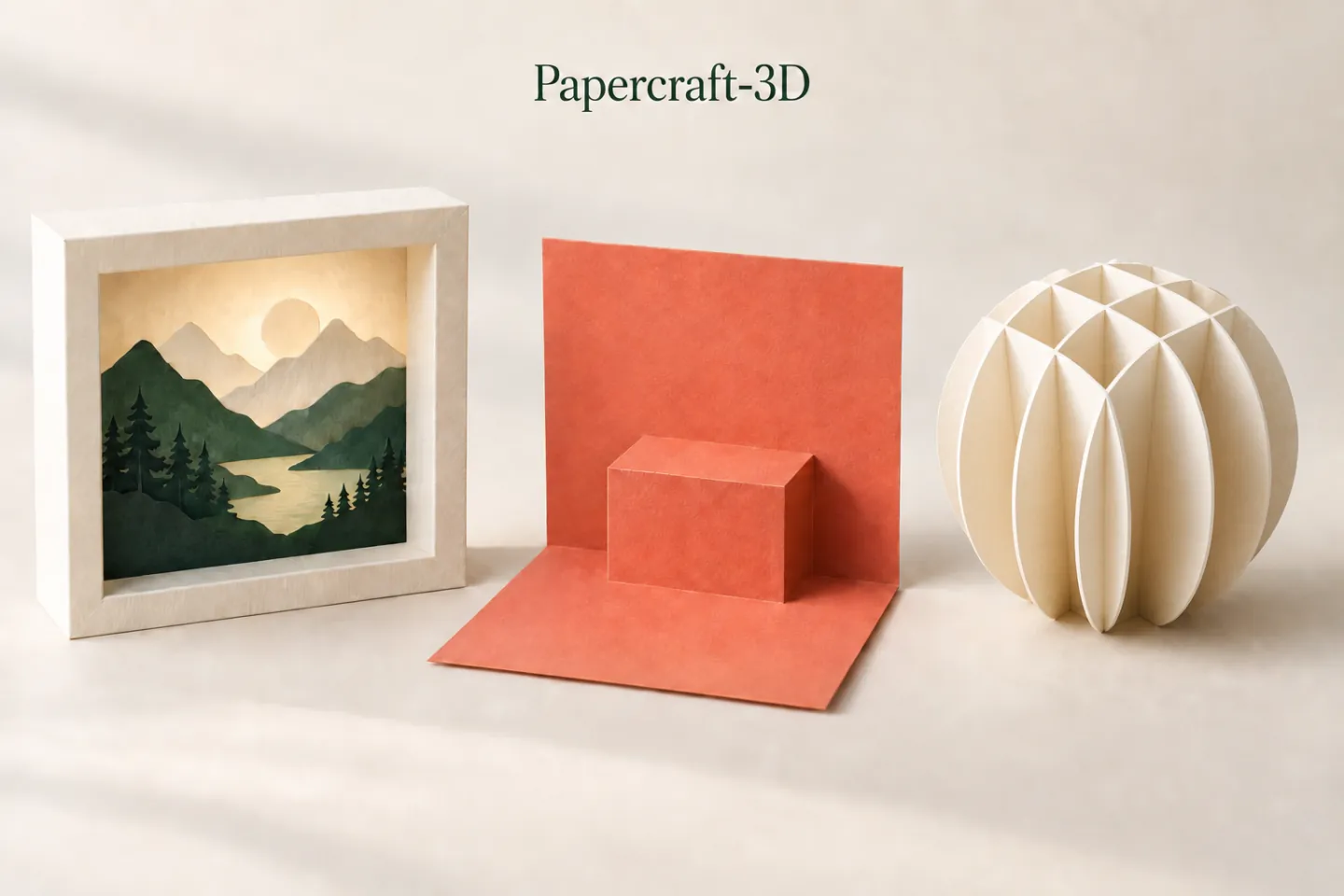
A sliceform is a volumetric shape built from flat paper slices, cut with slots, then assembled at right angles. This page explains the general principle and points you to the concrete template on the site.
How slotted slices work
Each slice is a flat shape cut from paper or light card, with one or more slots so it can interlock with other slices without glue or extra fasteners. Assembling several slices on perpendicular axes creates a three-dimensional volume, even though none of the pieces is volumetric on its own.
Two slice families, one volume
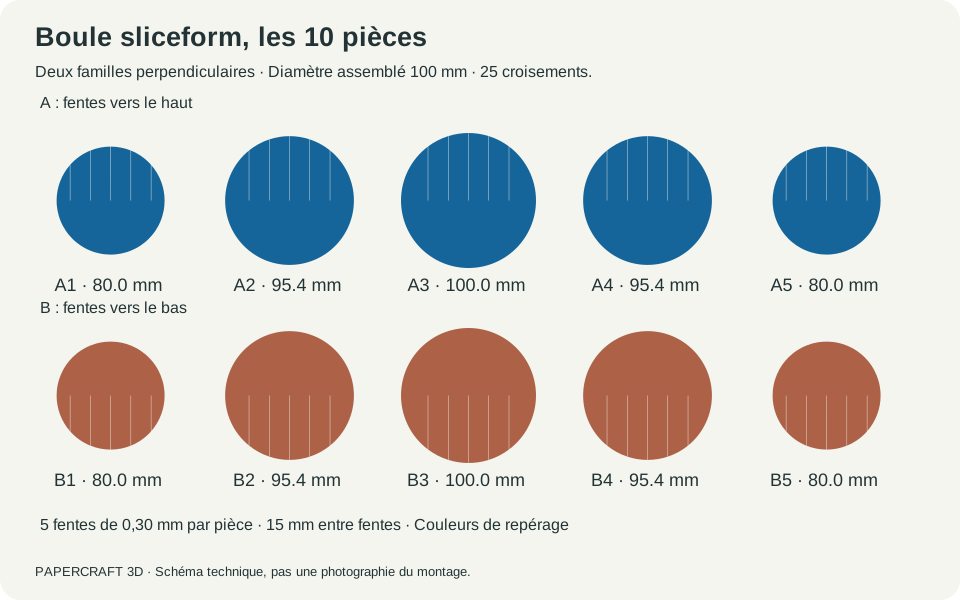
In a typical sliceform, the slices belong to two families set 90 degrees apart. Each slice in one family crosses several slices in the other, and that network of crossings holds the structure upright by friction in the slots.
Do not confuse sliceform, folded pop-up and glued papercraft
A sliceform is not a folded pop-up card, where relief opens and closes through articulated folds on a single sheet. It is also not a classic papercraft volume, assembled by gluing flat facets along their edges. A sliceform stands without folds or glue, only by the interlocking slots between slices.
| Technique | What creates the volume | Starter project |
|---|---|---|
| Sliceform | Crossing slices and fitted slots | Ten-piece sphere |
| Kirigami pop-up | Cuts and folds in a card | One-step card |
| Faceted papercraft | Folded parts and glued tabs | Small geometric volume |
How the silhouette changes with viewing angle
One distinctive trait of a sliceform is how strongly its visible silhouette changes with viewing angle. From the front you mainly see one family of slices; from a three-quarter view the two families mix and look denser. That shift with viewpoint is the visual interest of the technique.
The sphere as a concrete example
The template on this site applies the principle to a sphere: vertical slices in two families rotated 90 degrees cross to draw a volumetric ball. Other shapes follow the same geometry, such as an egg or a fir-tree silhouette, with contours and slot positions adapted to each outline. To start here, choose the 100 mm sphere available for download.
Paper thickness, weight and level of detail
Slot width must match the real thickness of the paper, not only the weight printed on the pack: two papers of the same gsm can differ slightly depending on composition. Thicker paper makes a sturdier structure, but fine contour details lose precision when cutting.
Can you use any type of paper?
Not entirely. Paper that is too soft will not keep the slices upright, while paper that is too stiff makes fine details harder to cut. Light cardstock, neither too soft nor too thick, is usually a reasonable starting point.
Does a sliceform fold flat like a pop-up?
Some sliceforms can flatten by rotating their slices in the slots. That depends on geometry, tolerance and paper flexibility. For the sphere template here, assemble the families at 90 degrees and do not force it flat: the 0.30 mm slots are sized to fit the paper.
To download the full 10-piece sphere template and follow the detailed assembly method, go to our page free sliceform template, the 10-piece paper sphere.